Kalispell’s climate puts commercial roofs through a punishing annual cycle. Snowpack builds pressure through winter, spring thaw sends meltwater across flat surfaces looking for any gap, and summer UV degrades membrane materials from above. When something goes wrong, it rarely announces itself early. By the time a building owner notices a ceiling stain, the source is often months old. Flat roof repair in Kalispell, MT requires someone who understands how regional conditions translate into specific failure patterns.
Call Flag Ship Foam & Coatings at (208) 946-3031 for flat roof repair in Kalispell, MT.
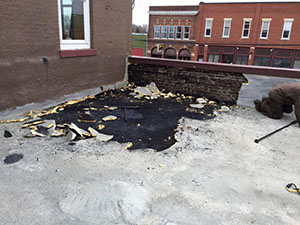
Flat Roof Repair: What Goes Wrong and Why
The most common source of flat roof failure in western Montana is flashing. Flashing seals the edges where a roof membrane meets walls, curbs, drains, and penetrations like HVAC equipment and pipe boots. Both bonded and mechanically fastened flashing are vulnerable to Kalispell’s freeze-thaw cycles. When temperatures drop below freezing repeatedly, expansion and contraction break bonds, pull fasteners loose, or open seams that were tight all summer. Water enters through those points and travels horizontally between insulation layers before finding a path to the interior, which is why the visible leak rarely lines up with the actual entry point.
Membrane seams are the second major failure area. Single-ply systems like TPO and EPDM are installed in sheets joined at seams. Heat-welded TPO seams weaken from age and thermal movement. EPDM seams rely on bonding adhesives that soften in hot weather or stiffens and cracks in cold. A failed seam just a few inches long can allow enough water intrusion to saturate several feet of insulation before damage becomes visible inside the building.
The Cost of Waiting
Building owners sometimes postpone repairs hoping to bundle them into a larger project. This approach usually costs more than it saves. Water sitting in saturated insulation does not dry out. Insulation that stays wet loses thermal value, adds weight to the roof deck, and can degrade the deck material below. A small repair handled early can become a full restoration project if the damage spreads through an entire winter. Ponding water accelerates this. Drain cleaning and minor regrading are often part of a flat roof repair assessment because they address the source rather than just the symptom.

Flat Roof Repair Process
A proper flat roof repair starts with locating the actual entry point, not just where damage shows inside. Moisture scanning equipment identifies saturated insulation zones across large roof areas without removing the entire membrane. Once entry points are mapped, the scope becomes clear. The affected section is cut back, wet insulation replaced, and a compatible patch applied without disturbing the rest of the roof.
Flashing repairs follow a similar approach. A deteriorated counterflashing, a lifted pipe boot, or a failed coping cap joint can each be addressed once identified. The goal is to restore the waterproof barrier at every entry point, so the rest of the roof continues performing. When the overall membrane is still serviceable, repair is far more cost-effective than early replacement.
Flat Roof Repair in Kalispell, MT
The flat roofs on commercial buildings in Kalispell face a combination of stresses that make professional assessment valuable even when damage appears minor. What looks like an isolated leak is often the end of a water path that started elsewhere. For flat roof repair in Kalispell, MT contact Flag Ship Foam & Coatings at (208) 946-3031 today.
FAQ
How do I know whether my flat roof needs repair or full replacement?
The condition of the membrane and insulation determines the answer. If the membrane is intact across most of the roof and saturation is limited, repair is usually the right call. If testing reveals widespread saturation or the membrane has reached the end of its service life, a coating restoration or full replacement may be more cost-effective long-term. A professional assessment will clarify which applies.
Can flat roof repairs be done in Kalispell winters?
Yes, with the right materials. Some products require minimum temperature thresholds to cure, so timing and product selection matter. Emergency repairs can be completed in cold weather using compatible formulations. Planned work is often scheduled for spring when conditions allow for thorough membrane preparation.
What makes flat roofs fail faster in colder climates?
The freeze-thaw cycle is the primary factor. Water expands when it freezes, widening any seam gap, flashing opening, or membrane crack each time temperatures drop. Over multiple winters, small imperfections become significant failures.