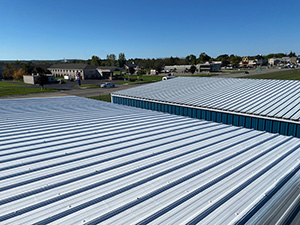
For commercial property owners in Sandpoint, ID, metal roof restoration can be a practical alternative to replacement when the existing roof is still a sound candidate. The decision should begin with the roof’s condition, including corrosion, seams, fasteners, moisture, drainage, substrate integrity, and system compatibility. Flag Ship Foam and Coatings provides commercial roof coating and restoration services in Sandpoint. Call 208-946-3031 to discuss whether restoration fits the roof.
When Metal Roof Restoration Makes Sense
Restoration is most useful when the existing metal roof remains serviceable overall and the problems can be corrected without replacing the entire assembly. Surface corrosion, localized seam or fastener issues, weathered finishes, and repairable flashing details may support a restoration approach when the underlying metal and roof assembly remain suitable.
Restoration can also reduce tear-off waste because more of the existing roof stays in place. That benefit depends on how much material can be retained and what repairs are required before coating. It should not be treated as proof that restoration is always the greener choice for every roof.

What Should Be Checked Before Coating?
A restoration assessment should look at the complete roof rather than the visible metal surface alone. Important questions include:
| Factor | What to Evaluate | Why It Matters |
|---|---|---|
| Moisture | Evidence of wet insulation, concealed moisture, or repeated leak areas | Coating does not dry saturated insulation or correct hidden moisture by itself. |
| Adhesion | Surface condition, oxidation, contamination, and previous coatings | The selected restoration system has to bond to the prepared roof surface. |
| Metal condition | Surface rust, pitting, holes, damaged panels, and attachment points | Surface deterioration may be restorable, while severe metal loss can require repair or replacement. |
| Drainage | Drains, gutters, low areas, and recurring ponding | A coating does not create proper drainage or correct structural low spots. |
| Compatibility | Existing roof material, old repairs, sealants, and prior coatings | Incompatible materials can interfere with adhesion or system performance. |
The evaluation method should match the roof and suspected condition. Moisture concerns, for example, may require further investigation before the restoration scope is finalized. One inspection method should not be presented as mandatory for every building.
When Coating Is Not Enough
Coating should not be used to hide conditions that need repair first. Saturated insulation, rotted or otherwise deteriorated decking, severe through-corrosion, failed attachment points, or unresolved drainage problems can change the recommendation. Depending on the extent of those conditions, the roof may need localized repair, selective replacement, or a broader replacement approach instead of restoration.
The same applies to active leaks. A leak location should be investigated so the source can be addressed. Coating the visible surface without correcting the underlying defect can leave the original problem in place.
Preparation and Repair Come Before Application
A sound restoration scope should explain how the existing surface will be prepared, what corrosion or repair work is required, how seams and fasteners will be addressed where needed, and what conditions would prevent coating from proceeding as planned.
Cleaning, repairs, primers, reinforcement, and application requirements vary by roof condition and coating system. The contractor should follow the requirements for the selected materials and documented substrate rather than relying on a single universal sequence for every metal roof.
Reflectivity and Energy Performance Need Qualification
Many roof coatings are reflective and can reduce solar heat gain compared with darker surfaces. Whether that produces meaningful building-level energy savings depends on the roof assembly, insulation, HVAC system, building use, roof area, climate, and operating schedule.
Reflectivity can be a useful project factor, but it should not be presented as a guaranteed cooling-cost reduction, emissions reduction, payback period, or improvement in insulation value. The coating is part of the roof surface, not a substitute for thermal insulation.
Restoration, Repair, or Replacement?
The strongest decision is based on documented conditions. Restoration may make sense when the roof remains sound enough to retain, needed repairs are manageable, adhesion is achievable, moisture is understood, and drainage does not create an unresolved limitation. Localized repair may be more appropriate when the problem is limited and a full restoration system is unnecessary.
Replacement may deserve consideration when panel deterioration, substrate damage, moisture, attachment failure, or other defects are too extensive for a reliable restoration scope. Flag Ship Foam and Coatings’ verified commercial scope includes coating and restoration of existing roofs; this page does not imply that the company provides new metal roof installation or replacement.
Closeout and Ongoing Maintenance
After restoration, project closeout should document the completed scope, repaired areas, coating or system information, approved changes, and any locations that should be monitored. Future inspection frequency should reflect roof condition, exposure, rooftop activity, leak history, drainage, maintenance needs, and applicable warranty requirements.
Metal Roof Restoration in Sandpoint, ID
For a Sandpoint commercial property, metal roof restoration is most defensible when the existing roof has been evaluated for moisture, adhesion, metal condition, drainage, compatibility, and repair needs. If restoration is appropriate, retaining serviceable roof components can reduce tear-off and material use. If the roof is not a sound candidate, repair or replacement should be considered instead of forcing a coating solution. Call Flag Ship Foam and Coatings at 208-946-3031 to discuss the roof condition and restoration options.
Frequently Asked Questions
Is metal roof restoration more environmentally friendly than replacement?
It can be when the existing roof is suitable to retain because restoration may reduce tear-off waste and new material use. The actual environmental benefit depends on the repairs, materials, and project scope.
Can a rusted metal roof still be restored?
Sometimes. Surface corrosion may be treatable, but severe pitting, holes, loss of metal, or failed attachment points can require repair or replacement before coating is considered.
Does restoration fix ponding water or saturated insulation?
No. Coating does not correct drainage defects, dry saturated insulation, or repair deteriorated decking. Those conditions need separate evaluation and corrective work.
How often should a restored metal roof be inspected?
There is no universal interval. Inspection frequency should reflect roof condition, exposure, rooftop activity, leak history, drainage, maintenance needs, and applicable warranty requirements.