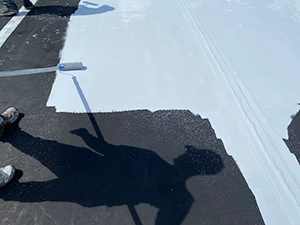
For a commercial property in Moscow, ID, a rubber roof leak should be evaluated before anyone assumes it is either a simple patch or evidence that the whole roof is failing. The useful question is whether the defect is localized and the surrounding roof remains serviceable, or whether moisture, repeated seam failures, drainage, or substrate damage point to a broader problem. Flag Ship Foam & Coatings serves commercial properties throughout northern Idaho. Call 208-946-3031 to discuss a roof assessment.
Is This a Localized Rubber Roof Repair or a Broader Roof Problem?

A ceiling stain shows that water reached the building interior, but it does not identify the exact entry point or prove how far moisture has traveled within the roof assembly. The repair scope should follow roof-level evidence.
| Observed Condition | What the Inspection Should Check | What It May Indicate |
|---|---|---|
| One separated seam | How much seam is open, whether nearby seams show the same condition, and whether the surrounding membrane remains serviceable | One contained seam defect may support a localized repair. Repeated seam failures can justify a broader assessment. |
| Leak near a vent, curb, or other penetration | The full flashing and termination detail plus the adjacent membrane | One failed detail may be repairable if surrounding materials remain sound. Similar failures at several penetrations can expand the scope. |
| Damaged edge or wall flashing | Whether the damage is isolated and whether nearby transitions remain secure | Limited flashing damage may stay localized. Widespread deterioration suggests more than a spot repair. |
| Suspected moisture beneath the membrane | The extent of the suspected area and whether important screening findings need confirmation | Confirmed localized moisture may require removal of affected materials. Wider moisture can require a larger investigation and repair scope. |
Moisture Screening Is Not the Same as Confirmed Damage
Infrared imaging and other moisture-screening methods can help identify areas that deserve closer investigation, but a temperature difference is not automatic proof of wet insulation. Roof construction, recent weather, surface conditions, insulation type, and the timing of the scan can affect the result.
If a suspected wet area would materially change the repair scope, the contractor should explain how that finding will be confirmed. The appropriate method depends on the roof assembly and the condition being investigated, so one diagnostic tool should not be presented as conclusive for every roof.
What Modern Diagnostics Can and Cannot Do
Drone imagery can help document large roof areas, surface damage, drainage patterns, and hard-to-see locations. Electronic leak-detection methods can be useful on compatible assemblies when the test conditions and roof system support their use. These tools can improve the investigation, but they do not replace visual inspection, roof-history review, and confirmation of findings that affect the proposed scope.
The contractor should identify which diagnostic method was used, what it actually found, and where the method has limitations. That distinction helps an owner understand whether the recommendation is based on an observed defect, a screening result, or a condition that still needs verification.
Repair Materials Should Match the Existing Roof
Rubber roof repairs may involve compatible membrane patches, seam materials, flashing components, sealants, or liquid-applied products, depending on the existing roof and the defect. The material choice should follow the installed system and the condition found during inspection rather than a one-size-fits-all product claim.
For a related same-client repair example, Flag Ship Foam & Coatings also has a flat roof repair page for Moscow. That page is a separate destination, so this article remains focused specifically on the evidence needed to decide whether a rubber-roof defect can stay localized.
What a Rubber Roof Repair Quote Should Include
A useful quote should identify the repair location, the defect being addressed, the proposed method and materials, required preparation, access assumptions, exclusions, and conditions that could expand the scope after work begins. If wet insulation, deteriorated substrate, or another concealed condition would be handled separately, the proposal should explain how that discovery will be documented and approved.
Access planning also matters. The contractor should determine the safe route to the roof, staging needs, protection for occupants and equipment, and any operational restrictions before work starts. Building owners should provide access information and site constraints rather than attempting roof-level diagnosis themselves.
When Replacement Should Enter the Conversation
A repairable defect does not become a replacement project simply because the roof is old. Replacement becomes a broader consideration when inspection findings show repeated failures across different areas, widespread moisture, deteriorated components that cannot remain, or an assembly that can no longer support reliable localized repairs.
Flag Ship Foam & Coatings maintains a separate flat roof replacement page for Moscow. Comparing those two scopes can help an owner understand why repair and replacement are different decisions even when they involve the same building.
Rubber Roof Repair in Moscow, ID
Flag Ship Foam & Coatings has served commercial, industrial, and agricultural properties across Montana and northern Idaho for 20 years. For a Moscow building owner, the key question is whether the evidence supports a contained repair or shows that the roof needs a broader condition review.
Call 208-946-3031 to discuss rubber roof repair in Moscow, ID and the inspection evidence that should support the recommended scope.
Frequently Asked Questions
Can a rubber roof leak be diagnosed from a ceiling stain alone?
No. A stain confirms interior moisture but does not establish the entry point or how far water has traveled within the roof assembly.
When is a rubber roof defect suitable for localized repair?
A localized repair is more reasonable when one defect can be identified and the surrounding membrane, insulation, drainage, and supporting materials remain serviceable.
What should a rubber roof repair quote include?
It should identify the defect, location, repair method, materials, preparation, access assumptions, exclusions, and how concealed conditions that change the scope will be handled.
When should a broader roof assessment be requested?
Request one when seam or flashing failures repeat, moisture extends beyond one area, drainage problems recur, or wider deterioration makes another spot repair unreliable.