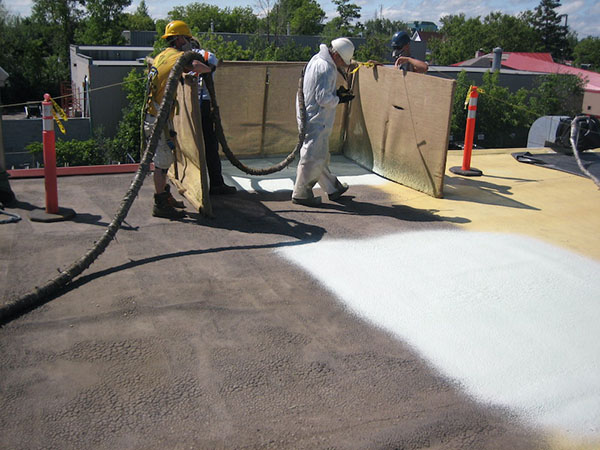
Spray foam roofing can be a useful option for some commercial buildings in Libby, MT, but it should be selected based on the existing roof and project requirements rather than treated as a default solution. Flag Ship Foam & Coatings confirms spray foam installation within its commercial roofing services and serves Libby as part of its approved Montana service area.
Property owners can call (208) 946-3031 to discuss whether spray foam roofing should be evaluated for a specific building.
How Spray Foam Roofing Works
Spray polyurethane foam roofing is created by applying liquid components that react and expand into a continuous foam layer over a prepared roof surface. The completed roofing assembly also includes a protective coating over the foam. System thickness, preparation, coating requirements, and installation details depend on the project and product specifications.
Because the material is applied in place, it can conform around curbs, penetrations, equipment, and irregular roof features. Careful detailing is still required at drains, edges, penetrations, transitions, and other areas where the roofing system connects to the building.
Start With the Existing Roof Condition

Before spray foam is selected, the current roof should be evaluated for surface condition, moisture, drainage, substrate or deck concerns, previous repairs, and other conditions that could affect the proposed system.
A roof should not be treated as a good candidate simply because it is older or low-slope. Wet materials, damaged supporting components, contamination, incompatible surfaces, or unresolved drainage problems may require separate work or a different roofing approach.
Surface Preparation and Compatibility Matter
Spray foam has to bond to the prepared surface, so cleaning, repairs, removal of loose material, primers, or other preparation may be needed depending on the existing roof and the selected system.
Compatibility should be confirmed for the specific roof rather than assumed from a broad material category. Existing membranes, coatings, repairs, moisture, contaminants, and surface condition can all affect what preparation is appropriate.
Drainage Problems Need Their Own Evaluation
Spray foam should not be presented as an automatic fix for ponding or poor drainage. Water that remains on a commercial roof can involve slope, drains, scuppers, settlement, blocked outlets, or other conditions.
The project should identify whether drainage concerns exist and whether corrective work is part of the proposed scope. Any use of foam thickness or project-specific shaping should follow the roof design and installation requirements rather than a general promise that spray foam will correct drainage.
Application Conditions Affect the Work
Spray foam application depends on suitable jobsite and surface conditions. Temperature, moisture, wind, humidity, and substrate conditions can affect whether work should proceed and how the materials cure.
The acceptable application window should follow the requirements of the selected system. Property owners should expect the contractor to account for weather and roof conditions rather than rely on one universal temperature or seasonal rule.
Understand the Protective Coating
The foam layer is normally protected by a coating system that helps shield it from exposure. The coating is part of the roofing assembly and should be considered during future roof inspections and maintenance planning.
There is no single recoating interval that applies to every spray foam roof. Timing depends on coating condition, exposure, maintenance history, rooftop activity, and the documentation for the installed system. Decisions should come from the roof’s actual condition rather than an automatic calendar schedule.
Energy Performance Should Be Discussed Carefully
Spray foam can add insulation value as part of a roof assembly, but building-level energy savings should not be guaranteed from the roofing material alone. Actual energy use depends on insulation levels, HVAC equipment, controls, building use, air leakage, climate, and other parts of the building envelope.
For owners also considering insulation work, Flag Ship Foam & Coatings has a separate page about foam insulation. Roofing and insulation scopes should be evaluated according to the actual building rather than treated as interchangeable services.
What to Ask Before Choosing Spray Foam Roofing
Before approving a project, ask how the existing roof was evaluated, whether moisture or drainage concerns were found, what preparation is included, how penetrations and roof edges will be handled, what protective coating is proposed, and what maintenance documentation will apply after installation.
It is also useful to compare the complete scope rather than only the initial price. Tear-off needs, repairs, preparation, access, rooftop equipment, coating requirements, and other project conditions can all affect cost. Property owners comparing contractors can review the company’s information about commercial roofing companies as a broader decision resource.
Spray Foam Roofing in Libby, MT
Flag Ship Foam & Coatings has been in business for 20 years and serves commercial, industrial, and agricultural properties throughout Montana and northern Idaho. Its confirmed commercial services include spray foam installation, acrylic and silicone coatings and restoration, TPO, PVC, and EPDM single-ply installation, and general commercial roofing.
For a Libby property, the decision to use spray foam roofing should come from the building’s actual roof condition, moisture, drainage, substrate compatibility, access, rooftop use, and project requirements. Contact Flag Ship Foam & Coatings at (208) 946-3031 to discuss whether spray foam roofing should be evaluated for the property.
Frequently Asked Questions
Can spray foam roofing be installed over an existing roof?
Sometimes, but not automatically. Existing materials, moisture, surface condition, compatibility, drainage, and project requirements all need to be evaluated first.
Does spray foam roofing require special maintenance?
Maintenance should reflect the installed system and actual roof condition. The protective coating, penetrations, drainage areas, and other exposed details can be included in appropriate inspection and maintenance planning.
How long does a spray foam roof last?
There is no universal lifespan. Installation quality, coating condition, maintenance, drainage, exposure, rooftop activity, and the overall roof assembly can all affect service life.
Is spray foam roofing more expensive than other commercial roof systems?
Not necessarily. Final cost depends on roof condition, preparation, repairs, access, project scope, coating requirements, and the complete roofing assembly, so a building-specific proposal is the best comparison.