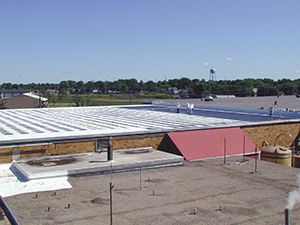
A commercial roof membrane is engineered to reach a specific service life, but reaching that lifespan depends on catching small problems before they grow into significant ones. Commercial roof inspections are the single biggest variable a building owner controls over how long a roofing system lasts.
Call Flag Ship Foam and Coatings at (208) 946-3031 for commercial roof inspections in Post Falls, ID.
How Small Failures Compound Without Regular Checks
Lifting flashing, separating seams, and slowing drains rarely start as serious problems. A flashing edge that has begun to lift slightly, a seam showing the first signs of separation, or a drain that has started collecting debris are issues that, caught early, involve a relatively small and inexpensive repair.
Left unaddressed, each of these small failures tends to worsen over time rather than stay static. Lifted flashing allows more water intrusion with each subsequent rain or snowmelt event, a separating seam widens under continued thermal stress, and a slow drain eventually blocks entirely, creating standing water that accelerates membrane wear in that area. Commercial roof inspections exist specifically to catch these issues at the inexpensive stage, before they compound into repairs that cost significantly more and take a real toll on the membrane’s remaining service life.
Freeze-Thaw Cycling and Why Timing Matters

Post Falls experiences real freeze-thaw cycling through the colder months, and that repeated freezing and thawing creates specific stress points on a commercial roof. Water that works into a small gap at a seam or flashing detail can freeze, expand, and widen that gap, then thaw and refreeze again as temperatures fluctuate, gradually turning a minor issue into a larger one across a single winter season.
The spring window, immediately after snowmelt, is the most critical inspection moment of the year for exactly this reason. This is when the cumulative effect of the winter’s freeze-thaw cycling becomes visible, and an inspection conducted at this point catches whatever damage accumulated over the preceding months before it sits through an entire additional season unaddressed.
Inspection Frequency as the Controllable Variable
Building owners cannot control the weather a roof faces, the building’s age, or how the original system was installed years earlier. What they can control is how often the roof gets inspected, and that single variable has an outsized effect on how close a roofing system comes to reaching its full designed lifespan.
A roof inspected consistently, with issues addressed as they are found, tends to reach the higher end of its expected service life. A roof that goes uninspected for extended stretches, even with the same underlying membrane material, tends to fall well short of that same lifespan, since small failures that would have been caught and fixed early are instead allowed to develop into larger problems that shorten the roof’s usable life.
Making Commercial Roof Inspections Part of Your Lifespan Strategy
Extending a commercial roof’s service life is less about the membrane material and more about how consistently small issues are caught and addressed before they compound. Commercial roof inspections, timed appropriately around Post Falls’ seasonal patterns, give a building owner direct control over that outcome.
For commercial roof inspections in Post Falls, ID contact Flag Ship Foam and Coatings at (208) 946-3031 today.
FAQ
How often should a commercial flat roof in Post Falls be professionally inspected to maximize its lifespan?
Most commercial roofs benefit from inspection at least twice a year, with the spring inspection after snowmelt being particularly important given the region’s freeze-thaw cycling. Older roofs or those with a documented history of recurring issues may warrant more frequent visits.
What does a commercial roof inspection in Post Falls look for, and how does the process differ from a basic visual check?
A thorough inspection examines seam and flashing condition in detail, checks drain function, and documents membrane wear in a way a casual walk across the roof surface would miss. This level of detail matters because many early-stage issues are subtle and easy to overlook without a trained eye looking for them specifically.
At what point does a commercial roof inspection reveal that repair is no longer enough and restoration or replacement is needed?
When an inspection reveals widespread issues across multiple areas of the roof, rather than isolated problems, or when the underlying membrane has degraded past the point that repairs hold reliably, that typically signals repair alone is no longer sufficient. At that stage, restoration or replacement becomes the more practical path.