Spray polyurethane foam roofing forms a continuous, insulating layer when applied to a suitable prepared roof surface and protected with a compatible coating. For commercial, industrial and agricultural buildings with flat or low-slope roofs, an appropriate scope must address substrate condition, thickness, penetrations, drainage and the protective coating rather than promise a leak-free result. Flag Ship Foam & Coatings provides spray foam roofing services in Coeur d’Alene, ID and across Montana and northern Idaho, and this guide explains how an owner can compare contractors and written scopes for a spray foam project.
The short answer is to compare scopes before prices. Two bids can look similar and describe very different work, so the useful comparison covers services, investigation, specification, exclusions, schedule, protection, references and warranty responsibilities. Our spray foam roofing page for Coeur d’Alene describes the service itself.
Our Services
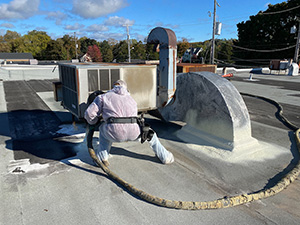
Flag Ship describes four kinds of spray foam roof work. A written proposal should distinguish the work priced for this property rather than assume that an installation quote also includes later maintenance or every possible repair:
- Installation: Foam is applied in place over a substrate that has been evaluated and prepared for the specified system, then protected with a compatible coating. The bid should state the proposed thickness, preparation and weather restrictions rather than assume that every existing roof can be coated directly.
- Repairs: Repairs address damaged, punctured or deteriorated areas, along with failed coating, flashings and penetrations. A repair bid should identify confirmed defects, possible moisture concerns and the limits of the proposed correction.
- Maintenance: Regular upkeep includes checking the coating, clearing drains and debris and attending to small defects early. Maintenance does not guarantee a particular lifespan, but it helps a spray foam roof perform as intended.
- Inspections: A specified inspection may document surface and detail conditions, coating wear, punctures, drainage and suspected moisture. Confirm whether photos, testing and a written report are included before assuming the inspection produces those deliverables. See our flat roof coatings guide for Coeur d’Alene for how coating condition affects restoration decisions.
Why Choose Us

Rather than asking an owner to take a claim on faith, the better question is what a contractor can document. Flag Ship has been in business for 20 years and works on commercial, industrial and agricultural roofs in Montana and northern Idaho. The client briefing lists system warranties of up to 20 years for qualifying roof systems, but that maximum is not a promise for a spray foam proposal. Ask which, if any, written warranty applies to the proposed assembly. The company information page gives general background; the actual proposed work and any coverage must be established in the project documents.
How to Compare Spray Foam Roofing Bids
Use this checklist side by side when reviewing two or more bids. Each row should be answered in writing in every bid before prices are compared.
| Bid item | What the written bid should state | Why it matters when comparing |
|---|---|---|
| Confirmed services | Whether the price covers installation, repair, maintenance or inspection, and which of these the contractor performs itself. | A bid for new foam and a bid for repairing existing foam are different jobs and cannot be compared on price. |
| Investigation scope | How the existing roof will be assessed first: visual survey, moisture testing, core samples or deck review. | Unresolved wet materials or an unsound deck can make an installation unsuitable; the bid should identify assessment limits. |
| Material and system specification | The foam type and density, the thickness in inches, the protective topcoat and its coverage, and any primer or surface preparation. | Foam thickness and coating specification affect scope and may change cost. Different specifications do not make for equivalent bids. |
| Exclusions | What is not included, such as deck repair, wet insulation removal, drain or flashing work, rooftop equipment, permits and disposal. | Exclusions often explain a lower price. A short exclusion list on one bid and a long one on another is a warning. |
| Scheduling | Start window, expected duration, weather and temperature limits, and what happens if conditions delay the work. | Foam application has limits on temperature, moisture and wind, so a firm date with no weather plan may not hold. |
| Occupied-property protection | How overspray, odors, ventilation, access and rooftop equipment will be handled while the building is in use. | Work near occupied spaces should address access, application drift, ventilation and cure requirements appropriate to the site. |
| References | How experience with the specific type of spray foam system and roof conditions will be reflected in the proposed installation and quality-control scope. | General roofing history alone does not define spray foam installation responsibilities, protection measures or acceptance checks. |
| Warranty responsibilities | Which part is the contractor’s workmanship warranty, which is the manufacturer’s material or system warranty, and what each covers and excludes. | The two are different promises from different parties, with different terms, and a long number alone does not describe either. |
Questions That Show Bids Cannot Be Compared
When two bids differ widely, follow-up questions usually reveal why. These are the most useful:
- What thickness of foam is priced, and over what area? If one bid prices a thicker application, the bids are not equal.
- Which topcoat and coating thickness or coverage are included? The number of passes and specified film thickness depend on the coating system, and different specifications should not be treated as equivalent.
- What happens if wet insulation or a damaged deck is found? Ask how the condition will be documented, evaluated and authorized as an additional scope before the work changes.
- Who performs the work, and who supervises it? The contractor should be able to explain how crews are managed on site.
- What are the weather and temperature limits for application? This shows whether the schedule is realistic for the season.
- What does the warranty exclude? Exclusions for ponding water, foot traffic or lack of maintenance change how useful a warranty is.
Workmanship Versus Manufacturer Warranty
A workmanship warranty is issued by the contractor and covers specified installation concerns subject to its written terms. A manufacturer warranty may cover specified materials or the roofing system, subject to the exact document, approved assembly, exclusions and maintenance obligations. A bid should identify whether each warranty is offered, who issues it, the coverage and exclusions, the claim process, and any conditions that may limit coverage. Ask for the actual warranty documents, not a summary.
Why the Lowest Price Is Not Always the Better Bid
A low bid can be a fair price for a smaller scope. It can also leave out investigation, thickness, topcoat or protection work that another bid includes. Matching the specification and exclusions first lets the owner compare like with like. Where the existing roof is not a suitable substrate for spray foam, the scope may need to shift to repair, coating or replacement. Our commercial roofing services page for Coeur d’Alene provides a separate service overview.
Next Steps
For commercial, industrial and agricultural buildings in Coeur d’Alene, ID and the surrounding region, a proposal for Flag Ship spray foam roofing should identify the actual roof conditions, work limits, specifications and any warranty documents. Call (208) 946-3031 or use the contact page.
Frequently Asked Questions
What should a spray foam roofing bid include?
A written bid should state the services covered, how the existing roof will be investigated, the foam and topcoat specification, thickness, exclusions, schedule, protection for occupied areas, references and who stands behind each warranty.
Is the lowest bid the best choice?
Not necessarily. A lower price may reflect different foam thickness, coating specification, investigation limits or exclusions. Bids should be compared only after their scopes and specifications match.
Does spray foam roofing need a protective topcoat?
Yes, spray foam is normally protected by a topcoat or coating to guard it from sunlight and weather. The bid should name the topcoat, its coverage and its recoat expectations.
What is the difference between a workmanship warranty and a manufacturer warranty?
A workmanship warranty comes from the contractor; a manufacturer warranty, if available, is issued under the manufacturer’s terms. Confirm which documents actually apply and review their coverage, exclusions and claim procedures.