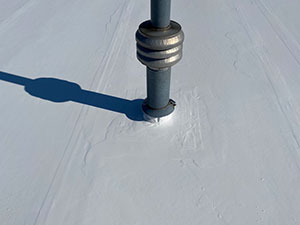
Flat roofs depend on sealed edges, penetrations and joints to keep water out, and flat roof caulking is the sealant used at many of those spots. The appropriate sealant must be compatible with the roof membrane, adjoining materials and expected joint movement. For commercial buildings in Kalispell, Montana, Flag Ship Foam & Coatings provides flat roof caulking when a compatible sealant is appropriate for the specific detail. To discuss your roof, call (208) 946-3031.
If you are evaluating a leaking membrane roof, our Kalispell rubber roof repair article covers related repair considerations. You can also review our membrane roof restoration service before discussing whether repair or restoration fits the roof’s condition.
About Flat Roofing
Flat roofing has a long history, but it is still a specialty. Low-slope roofs have drainage paths, membrane seams and transition details that need particular attention because water may remain near vulnerable openings. Recognizing trouble spots before they become serious is the core of flat roof care.
Most of those trouble spots are details rather than open membrane. Edges, penetrations, fasteners and drains are where materials meet, move and age. Kalispell’s winters add freeze-thaw cycles that open small gaps over time. Proper caulking is one of the preventive measures that keeps these details sealed.
Use of Flat Roof Caulking

Caulking seals weak spots where debris or water could otherwise enter. It is used around bolts, screws, roof edges and drain perimeters. For rubber roof systems, rubber roof caulking may be suitable at particular details when the product is compatible; membrane seams can instead require system-specific patches or seam materials. Done well, caulking helps protect the roofing materials underneath from water that leads to soft spots and deteriorating deck or insulation.
That kind of deterioration is often harder to catch than a direct leak, because it can go unnoticed for a long time. Prolonged water entry can damage insulation or decking, requiring investigation beyond surface sealing. Timely attention to an opening may reduce the scope of subsequent flat roof repair, although repair needs and costs depend on the condition found.
Where Caulking Is Used
- Roof edges and terminations: where the membrane meets the edge metal or a wall.
- Penetrations: pipes, vents, conduits and curbs that pass through the roof.
- Fasteners: exposed bolts, screws and plates that can back out or lose their seal.
- Drain perimeters: the joint between the drain and the surrounding membrane.
- Seams and small splits: locations that may need system-specific repair materials instead of general-purpose caulk.
What Caulking Can and Cannot Do
Caulking is a localized sealant. It works when the roof is basically sound and a specific joint or detail has opened. It does not repair a failed membrane, dry wet insulation or fix a drainage problem. Knowing which situation you have is the main decision for an owner. The table below lays out common observations and what they may mean.
| What you see | What it may indicate | Where caulking can help | Limitation |
|---|---|---|---|
| Cracked or shrunken sealant at edges and terminations | Sealant has aged and lost its bond or flexibility | Re-sealing the joint after removing failed material and preparing the surface | Does not help if the metal, flashing or substrate behind it has moved or failed |
| Open joints around fasteners, penetrations and drain perimeters | Small gaps where water can enter | Compatible sealant at the detail when appropriate | Not a substitute for replacing a damaged boot, flashing or drain component |
| Soft or depressed area reported by a qualified roof inspector | Wet insulation or deteriorated deck beneath the membrane | Investigation and likely repair before any sealing | Caulking cannot dry or restore wet or rotted material beneath it |
| Ponding water near a sealed detail | Drainage or slope problem | Drainage evaluation, with sealing as only one part of the repair | Caulking does not correct drainage defects |
| Interior stains that return after sealing | Leak path is elsewhere or the source was not found | Re-inspection to trace the actual path | Repeated sealing in the wrong place wastes money |
Practical Owner Observations
Owners and facility managers can notice a lot without leaving the building or climbing onto the roof. Look for water stains on ceilings, especially after snowmelt or rain. Watch for stains that return in the same spot. Do not step onto suspect roof areas. Photograph any standing water visible from a safe location after precipitation. Keep dated notes. They help a contractor see the pattern and help you compare one season to the next.
How a Contractor Should Assess the Roof
- Walk the roof and inspect edges, penetrations, fasteners, drains and seams.
- Photograph each finding and mark its location on a roof plan.
- Check for moisture or soft areas, and note where further testing would be needed.
- Look at the condition of existing sealant and what it is bonded to.
- Separate findings that need sealing from those that need repair or restoration.
- Provide a written scope so you know what will and will not be sealed.
When to Act
- Sealant is cracked, split or pulling away from a joint.
- A fastener or penetration shows exposed gaps.
- Stains appear inside the building after weather.
- A previously sealed area leaks again.
- A qualified inspector reports soft or depressed roof areas, which require evaluation before sealing.
Repeatedly applying sealant without identifying a broader defect can delay an effective repair. If the findings point past localized sealing, the options may include repair or restoration of the membrane, depending on its type and condition.
Discuss Flat Roof Caulking in Kalispell
If you manage a commercial flat roof, sealing the open details is one of the most practical ways to protect it. For commercial properties in Kalispell, Montana, Flag Ship Foam & Coatings can evaluate the roof and recommend the right caulking or repair approach. Contact the team at (208) 946-3031.
Frequently Asked Questions
Where is flat roof caulking used?
Compatible sealant may be used at roof edges, penetrations, exposed fasteners and drain details. Membrane seams may need system-specific repair materials.
Can caulking fix a roof that is already leaking badly?
Not usually. Caulking handles localized openings. Widespread leaks, wet insulation or a failing membrane typically need repair or restoration, and an inspection can tell you which applies.
How often should caulked areas be checked?
Check them during routine roof inspections and after severe weather. Sealant ages at different rates depending on exposure, so there is no single interval that fits every roof.
Does caulking correct ponding water?
No. Ponding points to a slope or drainage issue that has to be addressed separately.