Choosing a single-ply roof for a Kalispell building should start with the building, not with a list of headline benefits. The roof deck, drainage, insulation, rooftop equipment and access all affect which membrane and attachment method make sense. Flag Ship Foam & Coatings works with commercial owners in Kalispell, MT who want to understand those factors before choosing a system. To talk through your roof, call 208-946-3031.
Our single-ply membrane roofing overview provides more detail about the systems discussed here. If you are caring for an existing roof, our article on flat roof repair in Kalispell covers related problems and repair planning.
About Single-Ply Roofing
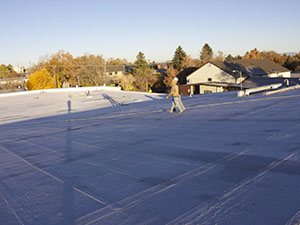
Single-ply roofing is a factory-made membrane installed over a flat or low-slope roof. Because the membrane comes in large sheets, a single-ply roof has far fewer seams than older built-up systems, though it still has seams at the edges of each sheet and at every detail. How well the roof performs depends on the system chosen, the quality of the installation and how the roof is maintained.
If you need a new roof, the common choices are EPDM, TPO and PVC. Each has its own strengths, and the best fit depends on your building, your budget and how the roof is used. The crew at Flag Ship Foam & Coatings can discuss which one suits your situation. Our team will help you work through the options. For a closer look at one of them, the Kalispell page on TPO roofing covers how to judge whether TPO suits a building.
The Three Common Membrane Types
- EPDM: a rubber membrane. Its seams are typically joined with adhesive or tape, and repairs use compatible rubber repair materials.
- TPO: a thermoplastic membrane. Its seams are typically heat-welded, and repairs must use TPO-compatible materials.
- PVC: a thermoplastic membrane that is also heat-welded at the seams. It is not interchangeable with TPO, and repairs must use PVC-compatible materials.
The membrane you choose determines how seams are made and how repairs are done later. A patch or repair product that works on one membrane can fail on another, so the contractor has to confirm what is on the roof before any repair or recoating.
Assessing the Building Before Choosing a System
An owner can use the matrix below to see which conditions favor single-ply and which need attention first. It is a starting point for a conversation with a contractor, not a substitute for a roof assessment.
| Factor | Usually supports single-ply | Raises a question first | Why it matters |
|---|---|---|---|
| Substrate condition | Deck is sound, dry and free of rot, with an existing roof that can be tested or removed as needed | Deck damage, wet insulation or unknown layers hidden beneath the roof | Repairs and testing come before any membrane choice |
| Drainage | Slope and drains move water off the roof in a reasonable time | Ponding from low spots, blocked drains or insufficient slope | A membrane does not fix drainage. Correct the cause or plan around it |
| Attachment | Mechanically fastened or bonded (adhered) attachment suits the deck and building | Deck or insulation cannot hold fasteners or cannot take adhesive | Attachment method affects cost, disruption and performance |
| Insulation | Insulation is dry, sound and compatible with the membrane and attachment | Wet, crushed or incompatible insulation | Wet insulation must be addressed under the selected assembly rather than concealed by a new membrane |
| Rooftop activity | Little foot traffic, with walkway protection where service access is needed | Heavy traffic, equipment service or kitchen exhaust grease | Traffic and exposure may favor one membrane or call for protection |
| Detailing | Penetrations, curbs, edges and flashings can be detailed with the chosen membrane | Many penetrations, complex curbs or tight transitions | Details cause many leaks, so they deserve as much attention as the field of the roof |
| Service access | Safe access to equipment and clear routes for maintenance | Equipment crowded together, or access that forces crews to walk on seams and flashings | Plan walkways and access before installation |
What the Contractor Must Confirm
- The type and condition of the existing roof and any layers beneath it.
- Whether insulation and deck are dry and sound, using moisture checks where needed.
- How water drains and whether any areas hold water.
- Which attachment method suits the deck, the insulation and the building.
- How penetrations, curbs, edges and flashings will be detailed.
- Which seam method the chosen membrane uses and what repair materials are compatible.
- Where walkways or protection are needed for service access.
Qualifying the Common Claims
Single-ply roofs are widely used, but no membrane is right for every building. Durability, energy performance and maintenance costs depend on the system, the installation, the climate and how the roof is used. Kalispell’s winter freeze-thaw cycles and snow loads make details and drainage especially important. Treat any claim that one membrane is best for every roof with caution, and ask the contractor to explain why a system fits your building.
Roof Coatings

Roof coatings can sometimes extend the life of an existing roof and delay replacement, which is why they come up alongside single-ply roofing. Whether a coating suits a particular single-ply roof depends on the membrane type, its condition, adhesion and whether the roof is dry. Coatings do not correct drainage defects or wet insulation. Our page on flat roof coatings in Kalispell explains what to check before a coating is applied.
Why Flag Ship Foam & Coatings?
Property owners comparing commercial roofing companies in Kalispell should ask how each proposed membrane fits the roof and its future service needs. Flag Ship Foam & Coatings has been in business for 20 years and serves commercial properties across Montana and northern Idaho. We focus on helping owners understand their options so the system they choose matches the building.
Discuss Single-Ply Roofing in Kalispell
At Flag Ship Foam & Coatings we provide single-ply roofing services to commercial clients in Kalispell, MT. If you would like to learn more about us, you can contact our team or call 208-946-3031.
Frequently Asked Questions
Which single-ply membrane is best for a commercial building?
There is no single best choice. EPDM, TPO and PVC each have strengths, and the right one depends on the roof deck, drainage, insulation, rooftop activity and budget.
Do single-ply roofs have seams?
Yes. They have fewer seams than older systems, but seams still exist at sheet edges and at details. How they are joined depends on the membrane.
Can I repair a single-ply roof with any patch material?
No. Repairs need materials compatible with the existing membrane, so the contractor has to identify what is on the roof first.
Can a coating be applied over an existing single-ply roof?
Sometimes. It depends on the membrane type, its condition and whether the roof is dry. Coatings do not fix drainage problems or wet insulation.