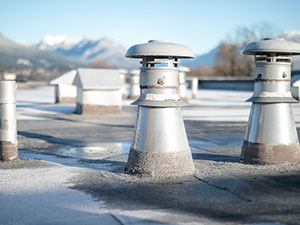
Flat roof caulking is the sealing of the small but critical joints on a low-slope roof: flashings, penetrations, curbs, terminations and open edges. When the sealant at these points cracks or pulls away, water gets in even though the main roof surface is still intact. Flag Ship Foam & Coatings provides commercial flat roof caulking and repair in Whitefish, MT and the surrounding area, working on commercial, industrial and agricultural roofs.
Caulking works well when the leak comes from a failed detail. It does not work when the cause is standing water, a worn-out membrane or wet insulation. The practical question for a building owner is which of those situations the roof is in, and this page explains how to tell.
Signs Your Flat Roof Needs Caulking
Look for these conditions, either from a safe vantage point or in an inspection report:
- Cracked, hardened or shrunken sealant around vents, pipes, skylights, curbs and roof drains.
- Gaps where flashing meets a wall, parapet or equipment support.
- Sealant that has separated from the surface or become hard and brittle.
- Open termination joints or membrane seams that may need a system-specific repair rather than sealant alone.
- Water stains on ceilings or walls, which can also result from plumbing or condensation and need source investigation.
- A musty odor or visible dampness indoors, which warrants investigation rather than assuming a roof leak.
Whitefish roofs go through hard freeze and thaw cycles and heavy snow, and the repeated expansion and contraction works on sealant joints. Flashing details and their sealant joints can deteriorate even when the roof field remains serviceable.
What Caulking Can and Cannot Do
Caulking is a localized maintenance measure. It is not a roof system. Use the table below to see how common observations line up with the right response.
| What you see | What it may indicate | Is caulking appropriate? | Limitation |
|---|---|---|---|
| Cracked, shrunken or pulled-away sealant at flashings, curbs and penetrations | Sealant has aged or the joint is moving | Potentially, when the detail remains sound and a compatible sealant is specified | Only as good as the surface preparation; a joint that keeps moving may need a flashing repair |
| Open seams or lap edges on the membrane | Seam adhesion or welds have let go | Usually not with caulking alone. Evaluate a compatible seam or termination repair | Sealant does not replace a system-approved welded, taped or bonded seam repair |
| Water stains inside, source not yet located | Leak path may be at a detail or elsewhere in the field of the roof | Not until the source is found | Sealing without confirming the cause may leave the water-entry path unchanged |
| Standing water that stays for days | Low spots or blocked drains | No. Caulking does not change drainage | Needs drainage correction, and wet areas may need to be checked for saturated insulation |
| Blisters, wide cracking or brittle surface across the roof | Possible widespread weathering or deterioration, with actual remaining service life requiring assessment | Caulking alone does not address widespread membrane deterioration | A broader repair, coating or replacement review is the next step |
Because the right answer depends on what is actually causing the leak, the first step is a roof assessment, not a tube of sealant. If the problems extend beyond details, a commercial roof restoration or, for an aging membrane, a flat roof replacement may be the better investment.
Cost-Effective Ways to Maintain Your Flat Roof

Routine care is how most owners keep small sealing jobs from turning into larger repairs:
- Inspect twice a year. Checking in spring and fall, and after major storms, catches failing sealant while the repair is still small.
- Keep drains and scuppers clear. Leaves, needles and debris hold water against details and speed up wear.
- Re-seal early. Sealant that is cracking but still attached is much easier to replace than a leak path that has already soaked the insulation.
- Document the roof. Dated photos of each penetration and flashing make it easier to see change from one inspection to the next.
- Match repairs to the membrane. Sealants and patching materials need to be compatible with the roof surface, which is why an EPDM roof is repaired differently than a TPO or coated roof. Our rubber roof repair in Whitefish page covers the EPDM side.
A roof coating is a different service from caulking. Its suitability depends on roof-system compatibility, moisture condition and the preparation specified for that roof.
How a Contractor Should Assess the Roof
A useful assessment gives the owner a clear scope. Expect the contractor to:
- Evaluate accessible roof areas relevant to the leak rather than assuming the interior stain marks the entry point.
- Check every penetration, curb, flashing and termination, and note which are failing.
- Look at drainage and look for ponding, clogged drains and low spots.
- Identify the membrane type, since it drives the repair method and the materials.
- Investigate suspected wet insulation and document where testing or further evaluation is needed.
- Describe the work in writing: what will be removed, cleaned, sealed or replaced, and what is outside the scope.
Proper caulking work includes cleaning and drying the joint, removing failed sealant, and applying new material in suitable weather. Applying sealant over dirt, moisture or unstable old material can compromise adhesion and shorten repair life.
When to Move Beyond Caulking
Treat these as triggers for a broader conversation about repair, restoration or replacement:
- The same detail has leaked after being re-sealed.
- Water stands on the roof for days after rain or snowmelt.
- Interior stains recur or appear in multiple areas, especially when their sources are not confirmed.
- The roof surface shows widespread cracking, blistering or open seams.
- Investigation confirms wet insulation or deteriorated substrate beyond a limited detail.
Flat Roof Caulking in Whitefish, MT
Flag Ship Foam & Coatings has 20 years in business and works across acrylic and silicone coatings and restoration, single-ply systems, spray foam and general commercial roofing, including repair and maintenance on flat roofs. Property owners in Whitefish can call (208) 946-3031 or use the contact page to discuss a roof. For a broader overview of service providers, see commercial roofing companies in Whitefish.
Frequently Asked Questions
How long does flat roof caulking last?
It depends on the sealant, the surface preparation, how much the joint moves and the exposure. Details with heavy movement or sun exposure wear out sooner, which is why periodic inspection matters.
Can caulking fix a leaking flat roof by itself?
Only when the failed sealant joint is confirmed as the water-entry path and the surrounding detail is sound. Failed membrane seams, drainage defects and wet insulation call for different repairs.
When is the best time to caulk a flat roof in Montana?
Sealants cure best when the surface is clean, dry and within the temperature range on the product label, so work is usually planned for dry, moderate weather rather than during freezing conditions.
Should I re-caulk myself or hire a roofer?
Walking a flat roof carries fall and membrane-damage risks, and the wrong sealant can fail or harm the membrane. A roofing contractor can identify the source and use a compatible material.