A flat roof leak does not automatically tell a commercial property owner whether the building needs one localized repair or a broader roof assessment. The useful question is how far the confirmed defect extends and whether the surrounding membrane, flashing, insulation, drainage, and substrate remain serviceable.
For commercial property owners in Butte, Montana, Flag Ship Foam & Coatings can evaluate the roof and help define an appropriate repair scope. Call 208-946-3031 to discuss the problem and arrange an evaluation.
What Does Flat Roof Repair Involve?
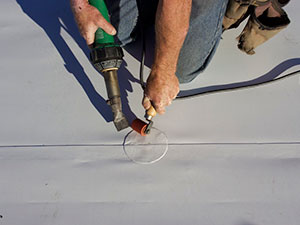
A useful flat roof repair process starts by identifying the roof system, locating the defect, and checking the surrounding area before deciding how much work is needed. The repair method should match the existing roofing material and the confirmed condition rather than treating every leak the same way.
Roof age can provide context, but it should not decide the scope by itself. Condition, previous repairs, moisture concerns, drainage, seams, flashing, penetrations, and substrate condition can all affect whether a limited repair remains practical. A roof inspection in Butte can help document those conditions before an owner approves the work.
Roof-level investigation and repair should be left to qualified roofing professionals. A visible stain or drip can identify where water became noticeable inside the building, but it does not by itself establish where water entered or how far it traveled through the roof assembly.
Localized Flat Roof Repair or a Broader Assessment?

The inspection should connect visible symptoms with roof-specific evidence before the final scope is set. A defined defect with serviceable surrounding materials may support a localized repair. Repeated failures, uncertain moisture extent, widespread drainage concerns, or deteriorated substrate can justify a broader assessment.
| Observed Condition | Evidence Needed Before Setting Scope | What It May Mean |
|---|---|---|
| Isolated seam separation | Confirm how much seam is affected, whether nearby seams show similar deterioration, and whether surrounding materials remain suitable for repair. | A clearly contained seam defect may support a localized repair. Similar failures in several areas call for a wider review. |
| One flashing or penetration defect | Inspect the full detail around the vent, curb, wall, drain, or other penetration and review adjacent roofing. | The visible opening may be repairable, but nearby deterioration or multiple failed details can expand the scope. |
| Localized puncture or membrane damage | Confirm the size and depth of the defect, nearby attachment or flashing conditions, and whether moisture extends beyond the damaged area. | A contained defect may be repairable if the surrounding assembly remains serviceable. |
| Ponding or suspected moisture in several areas | Determine whether the condition is isolated or repeated and whether further moisture, insulation, drainage, or substrate investigation is appropriate. | Repeated or uncertain conditions generally need broader evaluation before a repair scope is finalized. |
Ponding should be evaluated rather than assumed to have one cause. Drainage conditions can involve roof slope, drains, scuppers, blocked outlets, settlement, or other building-specific factors. If drainage correction is recommended, the proposal should explain what work is included instead of treating a patch or coating as an automatic solution.
What Should a Flat Roof Repair Quote Include?
A written quote should identify the repair location, the confirmed defect, the proposed materials or method, preparation, major exclusions, and any conditions that could change the scope after work begins. It should also explain how added work will be documented and approved if concealed damage is discovered.
Access planning matters as well. The contractor should address roof access, equipment staging, weather limitations, and any expected effects on entrances, parking, loading areas, rooftop equipment, or occupied spaces. Building staff should not have to access the roof to verify conditions themselves.
Warranty terms should come from the actual written repair and material documents. Coverage can vary by project, so owners should ask what is covered, what is excluded, and whether maintenance or notice requirements apply rather than assuming every repair carries the same warranty.
When Should Restoration or Replacement Be Considered?
A broader assessment does not automatically mean the roof needs replacement. It means the owner needs enough information to compare repair, restoration, and replacement based on actual roof conditions. If the existing roof remains suitable, roof coating and restoration in Butte may be one option to evaluate after compatibility, moisture, drainage, and preparation needs are reviewed.
Replacement may deserve consideration when deterioration is more extensive, the substrate or insulation has significant problems, repeated repairs are no longer holding, or the existing assembly is not suitable for the proposed repair or restoration approach. The recommendation should explain why the selected scope fits the roof instead of relying on age alone.
Flat Roof Repair in Butte, Montana
For a Butte commercial property, the repair decision should follow the evidence: identify the defect, determine whether it is truly localized, check surrounding conditions, define any unknowns, and make sure the written scope explains what happens if additional damage is found.
Contact Flag Ship Foam & Coatings at 208-946-3031 to discuss a flat roof repair assessment in Butte, Montana.
Frequently Asked Questions
Can a ceiling stain show exactly where a flat roof is leaking?
No. It shows where water became visible inside, but water can travel through the roof assembly before appearing at the ceiling.
What should a flat roof repair quote include?
It should identify the repair area, proposed materials or method, preparation, major exclusions, access needs, and how added work will be approved if concealed conditions change the scope.
When does a flat roof repair need a broader assessment?
A broader assessment is appropriate when defects appear in multiple areas, moisture extent is uncertain, drainage problems are widespread, substrate conditions are questionable, or repeated repairs are no longer holding.
Does a broader assessment automatically mean the roof needs replacement?
No. The purpose is to gather enough evidence to compare repair, restoration, and replacement based on the roof’s actual condition.