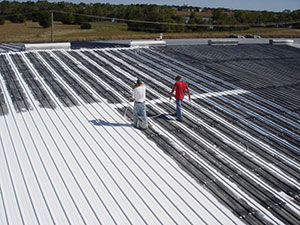
Metal roof restoration is a way to extend the service life of an existing metal roof by cleaning it, treating corrosion, sealing the weak points, and applying a protective coating, instead of tearing the roof off. Flag Ship Foam & Coatings provides metal roof restoration in Whitefish, MT and the surrounding Flathead Valley as part of its commercial roofing work, with warranty terms depending on the selected system.
Restoration is the right call when the metal panels are still structurally sound and the problems are on the surface: fading, early rust, failing sealant, or worn coating. It is not a coating-only solution when insulation is wet, decking is rotted, panels have lost their strength, or drainage defects cause standing water. Localized affected materials may be replaceable before restoration; extensive damage can make replacement more practical. A coating protects the metal it is applied to. It does not correct what is wrong underneath. This page explains how to tell the difference.
Signs Your Metal Roof Needs Restoration

The conditions below usually point to a roof that can be restored, provided the panels and substrate are still sound:
- Surface rust: reddish-brown patches, often starting at fasteners, laps, seams and cut edges. Light to moderate rust can be cleaned and treated. Metal perforated by corrosion needs a compatible panel repair or replacement before any coating is considered.
- Failing sealant: cracked or shrunken sealant around fasteners, seams, flashings and penetrations is a common source of small leaks.
- Chalking, peeling or faded finish: the original paint or coating is wearing away and no longer protecting the metal below.
- Loose or backed-out fasteners: screws that have worked loose with thermal movement leave openings that need to be addressed during preparation.
- Debris and trapped moisture: leaves, dirt and other buildup hold water against the metal and speed up corrosion.
- Water stains inside: stains on ceilings or walls are a reason to find the source before deciding on any coating.
Montana winters add freeze and thaw cycles, snow load and heavy temperature swings, and these movements work on fasteners and seams over the years. That is why a roof can look acceptable from the ground and still need attention at its details.
Restoration, Repair or Replacement: How the Decision Is Made
Condition drives the decision, not the age of the roof alone. The table below shows how common findings usually point toward restoration, localized repair first, or a different path.
| Condition | Usually points to restoration | Usually needs repair or replacement first |
|---|---|---|
| Moisture | Dry panels, dry insulation and decking, leaks traced to sealant or fasteners | Wet or saturated insulation or deteriorated decking; affected materials require assessment and appropriate replacement before coating |
| Adhesion | Existing finish is sound or can be cleaned and primed to a bondable surface | Existing coating is peeling in sheets or the surface cannot be cleaned to accept a new coating |
| Substrate condition | Surface rust only, panels solid, fasteners can be re-secured | Rust-through, weakened panels, rotted decking or a deck that cannot hold fasteners |
| Drainage | Water leaves the roof; low-slope areas shed water in a reasonable time | Ponding water caused by low spots or poor drainage, which a coating will not correct |
| Compatibility | A coating system suited to the metal, the existing finish and the roof slope is available | Existing materials or prior coatings that will not bond with a compatible system |
Some roofs need repairs first and a coating second. Replacing a few damaged panels, re-securing fasteners or fixing a drainage detail, then coating the whole roof, is a common sequence. Widespread or uncorrectable defects may favor replacement even if other conditions are satisfactory, and for flat or low-slope commercial roofs that decision is covered in our Whitefish flat roof replacement page.
The Metal Roof Restoration Process
A restoration project follows a planned sequence. Inadequate surface preparation, unresolved defects or incorrect application can compromise coating performance.
- Inspection: the roof is safely accessed and checked for rust, loose fasteners, open seams, damaged flashings, ponding areas and signs of wet insulation or decking. Findings decide whether restoration is appropriate at all.
- Cleaning: dirt, mildew, loose coating and debris are removed so the new materials can bond. A contaminated or unstable surface can prevent the new coating from bonding.
- Corrosion treatment and repairs: rust is removed or treated, damaged panels and flashings are repaired, fasteners are re-secured, and seams and penetrations are sealed.
- Coating application: a protective roof coating is applied to the prepared surface at the thickness the manufacturer specifies. Acrylic and silicone are two coating families used on commercial roofs, and the right choice depends on the metal, the existing finish, the slope and whether water collects on the roof.
- Acceptance check: after the required curing interval, the installed coating is checked against the specified coverage or thickness and the agreed repair details.
- Follow-up inspection: later inspections, including after severe weather when appropriate, check seams, fasteners, edges and any newly observed defects.
Our metal restoration service page covers the system options in more detail, and the Whitefish commercial roof restoration article explains how restoration works on other commercial roof types.
What Restoration Can and Cannot Do
A restored metal roof can gain a renewed protective surface, sealed details and a more uniform appearance without the cost and waste of tearing the old roof off. A reflective coating can lower the heat a roof absorbs in summer, but how much it reduces cooling cost depends on the building, its insulation and its use, so savings should not be assumed. The same applies to lifespan: how many added years a restoration provides depends on the condition of the roof beforehand, the preparation, the coating system and ongoing maintenance.
A coating cannot fix ponding water that comes from a drainage problem, rotted decking, or saturated insulation. Those conditions require evaluation and correction before restoration can be considered. For that reason, a careful inspection before any work is the most valuable part of the process.
Metal Roof Restoration in Whitefish, MT
Flag Ship Foam & Coatings has operated for nearly 20 years and focuses on commercial roofing systems, including acrylic and silicone coatings and restoration, single-ply systems and spray foam. Property owners with a metal roof in Whitefish can request an assessment to find out whether the roof qualifies for restoration, needs repairs first, or should be replaced. For a broader look at local options, see our page on commercial roofing companies in Whitefish. To discuss your roof, call (208) 946-3031 or use the contact page.
Frequently Asked Questions
How do I know if my metal roof can be restored instead of replaced?
Restoration usually works when the panels are structurally sound, the insulation and decking are dry, and the problems are surface rust, worn coating and failing sealant. Rust-through, wet insulation or rotted decking points toward repair or replacement.
Will a coating stop leaks on my metal roof?
It may address leaks traced to repairable seams, fasteners or surface defects after those defects are corrected. It cannot resolve drainage failures or concealed damage without additional work.
Does restoration fix standing water on a low-slope metal roof?
No. Ponding water is a drainage issue. A coating can protect the surface, but the low spots or drainage details have to be addressed separately.
What maintenance follows a restoration?
Follow the selected system’s maintenance requirements, keep records of periodic and post-storm inspections, and arrange compatible repairs when seams, fasteners or edges show new defects.