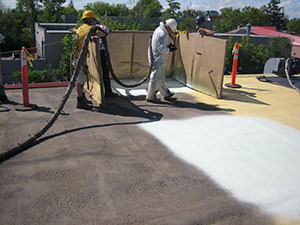
Spray foam roofing is a sprayed polyurethane foam that is applied as a liquid and expands into a continuous layer over the roof. For commercial buildings in Whitefish, MT, it can add insulation and a seamless waterproofing layer in one system. Flag Ship Foam & Coatings installs spray foam roofing for commercial properties and can help you decide whether it suits your roof. To discuss a project, call 208-946-3031.
For related planning information, read our article on spray foam insulation in Whitefish. Our Whitefish commercial roof restoration guide provides a broader look at evaluating an existing roof.
Spray Foam Roofing – The Benefit
Spray foam is an effective insulator, and because it is applied over the whole roof it can reduce the heat that moves through the roof and help regulate inside temperatures. That can help lower energy use, though the amount depends on the foam thickness, the building and how it is heated and cooled. Because it is sprayed on as one continuous layer, it has few joints where water can enter, and it can follow the shape of the roof around curbs and penetrations.
Foam is also lightweight, which adds little load to the structure, and it can often be applied over an existing roof that is dry and sound. After the foam cures, it needs a protective coating, because sunlight breaks down uncoated foam. The coating, along with correct detailing, is what lets the system stand up to Whitefish’s snow, freeze-thaw cycles and sun exposure. More on the system is on our spray foam roofing benefits page.
What Spray Foam Can and Cannot Do
Spray foam works best when the roof underneath is a good candidate. The table below covers what to weigh before you decide.
| Topic | What spray foam offers | Limitation to confirm | What it means for the owner |
|---|---|---|---|
| Insulation and energy | Foam adds insulating value and forms a continuous layer over the roof | Actual savings depend on the foam thickness, the building, how it is heated and cooled, and the existing insulation | Treat savings as estimates for your building, not guarantees |
| Waterproofing | The foam is applied as a seamless layer with few joints | It still needs correct details at penetrations, edges and drains, and a protective coating over the foam | Confirm the coating and details are part of the complete roofing scope |
| UV and weather exposure | A protective coating shields the foam from sunlight and weather | Uncoated foam is degraded by sunlight | Plan for the coating and for later recoating or maintenance |
| Existing roof condition | Dry, sound substrate that is clean and can bond with the foam | Wet insulation, rotten decking or contamination under the foam | Wet material must be removed or corrected before installation; foam should not conceal hidden moisture |
| Drainage and slope | Foam can be built up to improve drainage in some cases | Heavy ponding or poor slope may need correction beyond what foam alone solves | Drainage should be assessed before the system is chosen |
| Application conditions | Suitable temperature, dry surfaces and calm wind during application | Cold, wet or windy conditions can delay or limit work | Ask which surface and weather conditions are required for safe, specified application |
Practical Owner Observations
Owners and facility managers can notice a lot before a contractor visits. Note ceiling stains after snowmelt, areas of the roof that stay wet, high heating or cooling bills in specific zones and interior areas that feel damp or show recurring staining. Do not access the roof yourself. Keep dated photos taken from safe locations and notes, because they help a contractor see patterns and help you compare conditions from one season to the next.
How a Contractor Should Assess the Roof
- Identify the existing roof type and any layers beneath it.
- Check for moisture in the roof and insulation, using testing where needed, and mark any wet areas.
- Review drainage, slope and any ponding areas.
- Inspect penetrations, edges, drains and rooftop equipment that will need detailing.
- Confirm the foam thickness, the protective coating and the planned maintenance.
- Discuss the schedule and the weather limits on application.
- Provide a written scope that explains what is included.
When to Act
- Recurring leaks suggest the existing roof assembly needs an investigation before any foam system is chosen.
- The building is hard to heat or cool and the existing insulation is poor or damaged.
- The roof is aging but still dry and sound, so restoration or recovery is still possible.
- Suspected widespread moisture or deck deterioration requires broader evaluation and corrective scope first.
Spray Foam Roofing – The Cost

The installed cost of spray foam roofing depends on the existing roof, the repairs required, the specified foam and coating system, access and application conditions. Compare the complete scope with other suitable roofing options rather than assuming a particular first-cost or payback. It can also help lower heating and cooling costs over time, but those savings should be treated as estimates.
The cost depends on the roof’s size and complexity, access, the condition of the existing roof, the foam thickness, the protective coating and the project requirements. Ask for a written estimate that spells out what is included, and ask how maintenance and recoating will be handled. Compare the expected maintenance, recoating and future repairs alongside the initial cost, without treating savings as guaranteed.
Learn More Today!
Flag Ship Foam & Coatings provides spray foam roofing for commercial buildings in Whitefish, MT. Ask for an assessment that identifies the existing roof, confirms dry and sound conditions, and specifies the foam and protective coating in the written scope. Contact us today at 208-946-3031 to discuss your project.
Frequently Asked Questions
Does spray foam need a protective coating?
Yes. Sunlight breaks down uncoated foam, so the foam is covered with a protective coating that also needs periodic maintenance.
Can spray foam be installed over an existing roof?
Often, when the existing roof is dry, sound and clean. Wet insulation or rotten decking has to be repaired or removed first.
Will spray foam lower my energy bills?
It can reduce heat transfer through the roof, but savings depend on the foam thickness, the building and how it is used. Treat any figure as an estimate.
What affects the cost of a spray foam roof?
The roof’s size and complexity, access, existing roof condition, foam thickness, the protective coating and any repairs needed before installation.